Every growing business eventually reaches a financial inflection point where spending starts spiraling out of control. Department heads order software independently, vendor invoices arrive with unexpected price hikes, and office or plant managers spend valuable hours negotiating quotes rather than driving core business goals. That is when leadership begins asking: what is a procurement consultant, and what does a procurement consultant do?
Table of Contents
What Is a Procurement Consultant?
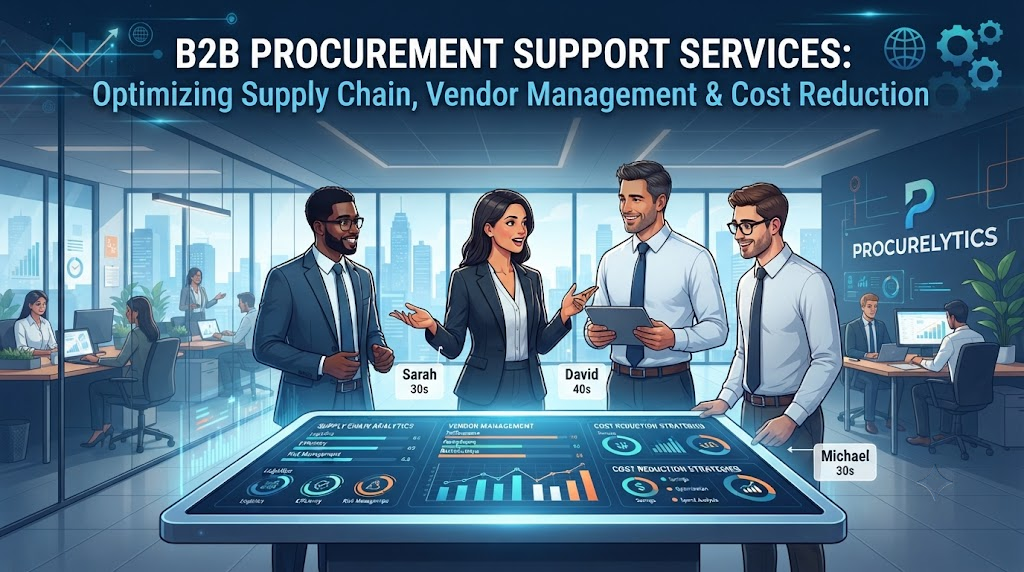
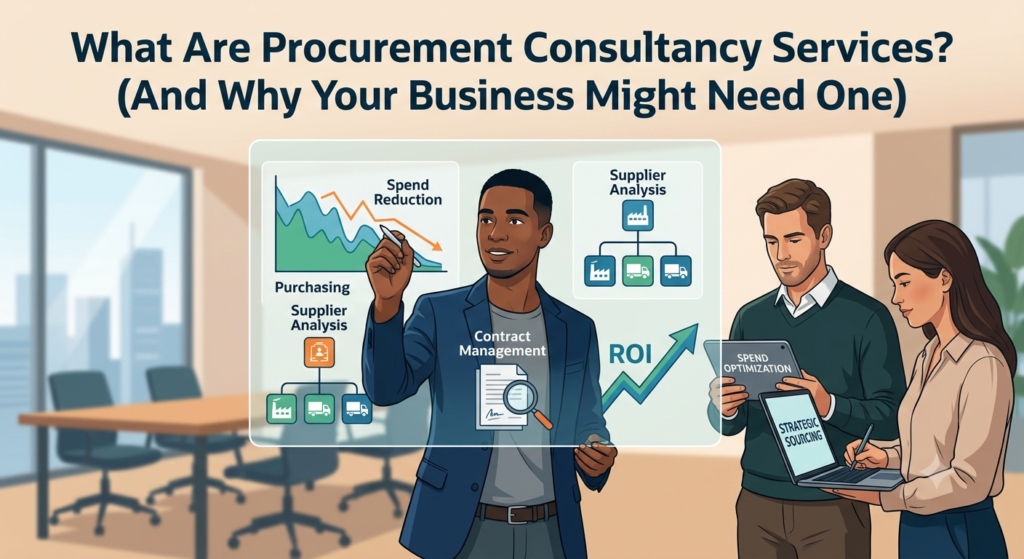
A procurement consultant is an independent commercial and supply chain specialist hired by an organization to evaluate, optimize, and restructure its purchasing operations. Unlike internal administrative staff who simply process purchase orders, a procurement consultant analyzes historical spend data, identifies supplier price gouging, conducts competitive market tenders, negotiates master contracts, and implements scalable sourcing workflows.
In mid-sized enterprises, hospitals, manufacturing plants, and fast-scaling startups, procurement consultants bridge the gap between chaotic ad-hoc purchasing and a mature, enterprise-grade supply chain function.
Explore Related Strategic Procurement Guides:
- What Are Procurement Consultancy Services? — In-depth overview of advisory offerings and sector applications.
- Industries Served: Tailored Procurement Execution — How specialized sourcing supports healthcare, startups, manufacturing, and education.
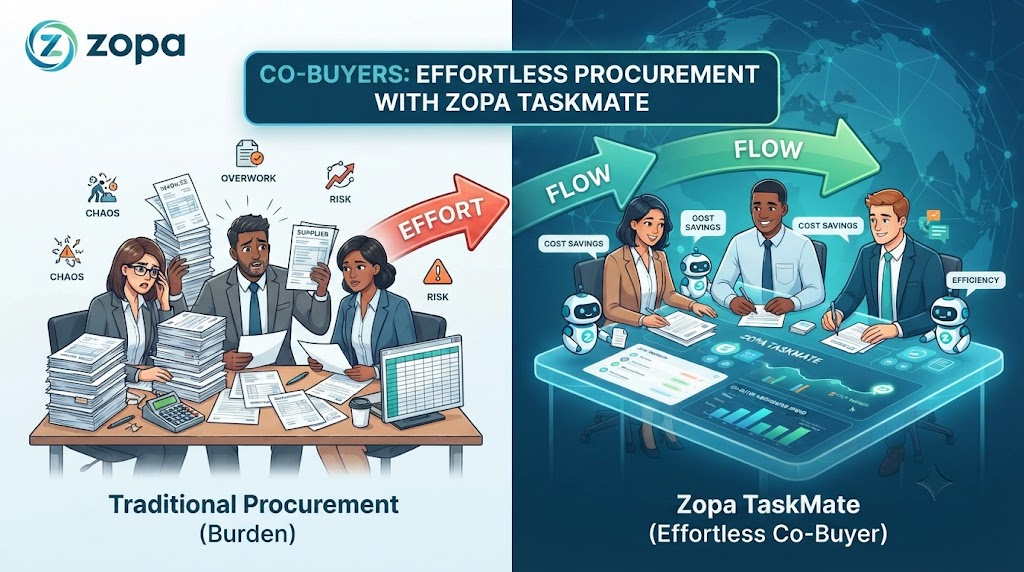
- Co-Buyers for Effortless Procurement — How ZOPA TASKMATE eliminates buyer burnout with on-demand execution.
- Mastering BATNA and ZOPA in Negotiations — Proven tactics to secure the best commercial pricing.
6 Key Responsibilities: What Do Procurement Consultants Actually Do?
While specific scopes vary across industries, an experienced procurement consultant executes six core commercial functions:
1. Spend Diagnostics & Forensic Auditing
Consultants extract 12–24 months of general ledger data, accounts payable receipts, and supplier invoices. They categorize every rupee into direct vs. indirect spend, uncover rogue “maverick spending” (unauthorized purchases outside contract), and flag supplier price creep.
2. Strategic Sourcing & Market Benchmarking
Instead of relying on the same legacy suppliers, consultants leverage proprietary market price databases to benchmark what your company should be paying. They identify qualified alternative tier-1 distributors, primary manufacturers, and wholesale sources.
3. Competitive Tendering (RFP & RFQ Management)
Consultants draft rigorous Requests for Proposal (RFPs) and Requests for Quotation (RFQs). They define technical specifications, enforce strict supplier delivery SLAs, and conduct multi-vendor bidding rounds that drive down costs through competition.
4. High-Stakes Contract & Commercial Negotiation
Equipped with superior market knowledge, consultants lead commercial negotiations on your behalf. They negotiate volume tier discounts, price-lock commitments, payment terms (Net 30/60), comprehensive warranty coverage, and Annual Maintenance Contract (AMC) terms.
5. Supplier Risk Assessment & Governance
A low price is worthless if a supplier defaults or ships counterfeit materials. Consultants evaluate vendor financial solvency, regulatory compliance (e.g., CDSCO, ISO, GST certifications), and supply chain continuity risks to ensure delivery reliability.
6. Digital Tool Implementation
Consultants modernize obsolete paper-and-spreadsheet workflows by deploying modern e-sourcing tools like ZOPA FLUX, bringing consistency, approval hierarchies, and automated purchase order tracking to your organization.
What Is Peculiar to the Procurement of Consultancy Services?
A frequent question asked by enterprise CFOs and procurement exam candidates is: “Which of the following is peculiar to the procurement of consultancy services compared to regular goods?”
When an organization procures consulting services, several unique characteristics distinguish it from standard commercial buying:
- Intellectual & Advisory Nature: You are procuring specialized cognitive expertise, analytical methodology, and strategic guidance rather than a physical commodity with predefined dimensions.
- Quality and Cost-Based Selection (QCBS): Standard goods are often awarded to the lowest compliant bidder. In consultancy procurement, the technical capability, credentials of the lead consultants, and proposed execution roadmap carry 70%–80% of the evaluation weight, with financial cost weighted at only 20%–30%.
- Dynamic, Milestone-Driven Scope: The scope of consultancy work often evolves as data audits reveal unexpected operational findings. Contracts must be structured with milestone deliverables rather than rigid unit delivery dates.
Procurement Consultant vs. In-House Head vs. Co-Buyer Partner
Before committing to an expensive consulting retainer or hiring a full-time procurement director, consider how different models compare:
| Evaluation Factor | In-House Procurement Team | Traditional Consultant | ZOPA TASKMATE Co-Buyer |
|---|---|---|---|
| Cost Structure | High fixed salaries, benefits & software licenses | Heavy monthly retainer ($5,000–$20,000/mo) | Flexible on-demand pricing / pay-as-you-grow |
| Primary Deliverable | Internal transactional order processing | Strategy reports & presentation slide decks | Turnkey execution: quotes, POs, fulfillment |
| Purchasing Leverage | Limited strictly to your company’s volume | Advisory benchmarking; no collective buying | Aggregated co-buying power unlocking Tier-1 rates |
| Speed to Savings | Slow (3–6 months onboarding and hiring) | Medium (8–12 weeks of audit and recommendations) | Immediate: Top-3 vetted comparatives in 24–48h |
| Contractual Lock-In | Permanent payroll liability | 6–12 month advisory commitments | Zero fixed commitment; total operational agility |
How Does Procurement Consulting Work in Practice?
A standard procurement consulting project unfolds across four sequential phases:
- Phase 1: Discovery & Spend Analysis (Weeks 1–3): Ingestion and cleansing of Accounts Payable data, vendor list rationalization, and calculation of baseline category spending.
- Phase 2: Strategy & Opportunity Sizing (Weeks 4–5): Identification of quick wins (high-cost items with readily available alternate vendors) and strategic re-tenders.
- Phase 3: Sourcing & Negotiation (Weeks 6–10): Publishing RFQs, vetting supplier technical bids, leading rounds of negotiation, and executing supplier agreements.
- Phase 4: Operational Handover & Governance (Weeks 11–12): Establishing standard operating procedures (SOPs), implementing purchase order governance, and training internal teams.
Cost of Hiring a Consultant vs. Co-Buying Economics
Traditional procurement consulting firms typically charge through one of three fee structures:
- Monthly Retainer: Commonly ranging from $5,000 to $25,000 per month depending on firm tier and scope complexity.
- Daily / Hourly Rate: Senior procurement advisors bill between $150 and $400 per hour.
- Gain-Share / Contingency: A percentage (typically 15%–30%) of documented first-year cost reductions.
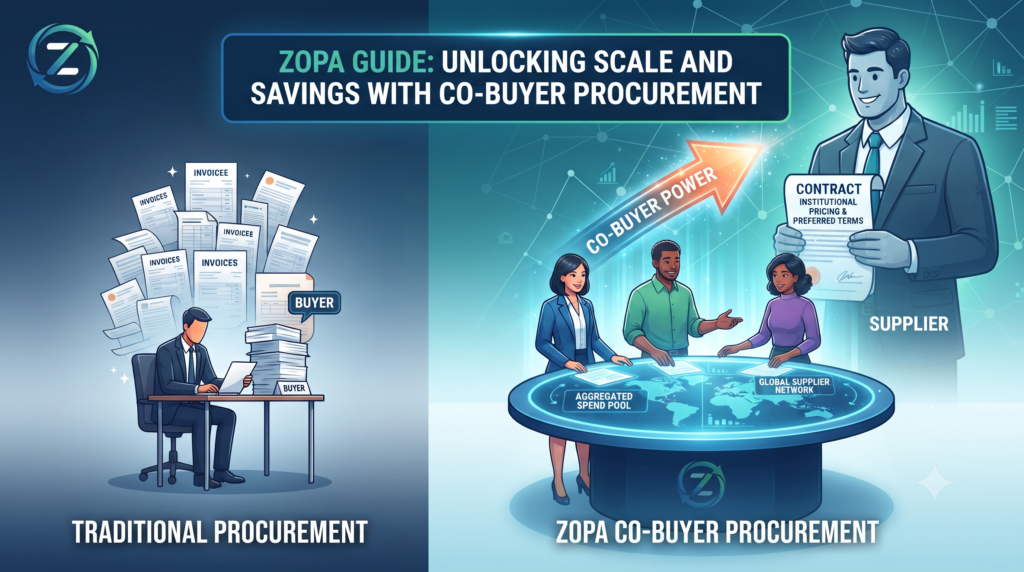
For small and mid-market organizations, these consulting fee barriers often consume a substantial portion of the expected savings. This economic reality has led hundreds of companies to adopt Co-Buying (Procurement-as-a-Service) through ZOPA, where dedicated buyers execute sourcing on demand, and savings are generated immediately through aggregated volume discounts.
When Should Your Business Hire a Consultant vs. an On-Demand Co-Buyer?
Choose a traditional procurement consultant if you are an enterprise with $100M+ spend undergoing an organizational restructuring, implementing a massive ERP system (SAP/Oracle), or conducting high-level corporate M&A supply chain due diligence.
Choose an on-demand co-buyer partner (ZOPA TASKMATE) if you are a fast-growing startup, healthcare provider, school chain, or manufacturing SME that needs immediate vendor quotes, lower purchase prices, zero employee headcount overhead, and end-to-end purchasing execution today.
Frequently Asked Questions (FAQ)
What is a procurement consultant?
A procurement consultant is an external purchasing specialist who helps organizations optimize their buying operations. They analyze spend data, benchmark supplier rates, lead competitive tenders, negotiate favorable contract terms, and establish procurement systems that reduce operational spending by 15% to 25%.
What do procurement consultants do on a daily basis?
On a day-to-day basis, procurement consultants audit vendor invoices, draft RFPs/RFQs, evaluate competitive bids, negotiate pricing and payment terms with supplier executives, resolve contract bottlenecks, and monitor supplier fulfillment performance.
How does procurement consulting work?
Procurement consulting operates through a structured four-stage cycle: forensic spend audit and baseline establishment, sourcing strategy formulation, supplier market tenders with structured negotiations, and long-term process implementation with digital governance tools.
Which of the following is peculiar to the procurement of consultancy services?
What is peculiar to procuring consultancy services is that the output is intellectual and advisory rather than physical. Consequently, evaluation relies on Quality and Cost Based Selection (QCBS) focusing on methodology and consultant credentials, rather than selecting the lowest price bid.
How does ZOPA TASKMATE compare to traditional consulting?
While traditional consultants leave you with strategic reports and high retainer bills, ZOPA TASKMATE acts as an on-demand co-buyer. We execute the actual purchasing, leverage aggregated group buying power to unlock tier-1 enterprise prices, and deliver top-3 vetted vendor comparatives in 24–48 hours with zero salaried overhead.
Conclusion & Next Steps
Procurement efficiency is no longer an optional back-office function; it is a direct driver of corporate profitability and operational resilience. Whether you choose a formal consulting engagement or partner with an agile co-buyer, taking control of your purchasing yields immediate margin expansion.
Ready to Transform Your Business Procurement?
Stop overpaying suppliers and eliminate administrative buyer fatigue. Let ZOPA benchmark your spend, deliver top-3 vetted vendor quotes in 24–48 hours, and reduce your purchasing costs by at least 15%.